
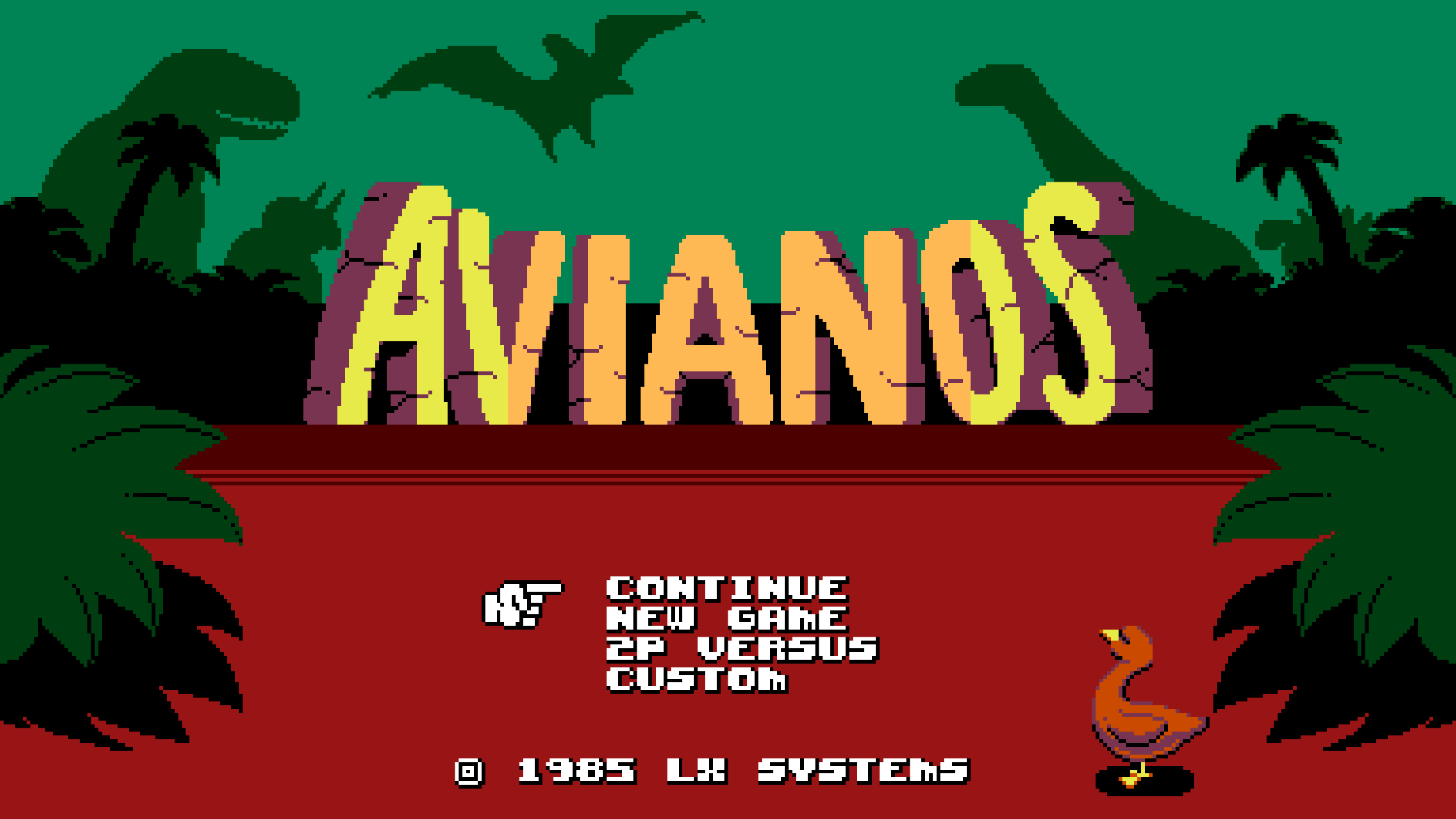
UFO 50 is a very unique game to come out last year, it is a library of games from a hypothetical game company. This unique parody of compilation games features 50 different games that all feel cohesive, thanks to a combination of palette choices and design decisions. One might think that because of the sheer number of games, there would be a dud here or there, but that is shockingly not the case. All of the 50 games are well designed and could merit a discussion on their own. Today, I will be focusing on one game that stood out to me, number 12: Avianos.
This up to 2 player strategy game is set in a medieval dinosaur setting where players choose 1 of 3 different dinosaur ancestors each turn, there being 5 ancestors in total, and invoking the power of said ancestor to the game field. The game field itself is divided into a five by four tile grid, where each tile features a mix of different terrain tiles or a castle tile. The player starts in control of one tower, and victory is achieved after the player controls a majority of towers or if they wipe out all of the enemy troops.

Each ancestor has 3 unique abilities that are used sequentially, as long as the player has the resources to use them. The main talents are Produce: gain resources based on structures on tiles you control, Build: create structures on tiles you control, Miracle: perform a strong action, Recruit: Gain more troops, Move: move your troops to a different tile, and Muster: gain troops based on structures. Most of those abilities cost resources like coins, bones, or workers, and some of those resources are limited, so you have to think carefully about how you spend your actions. Each time you use a character, you upgrade it, and every two times you visit, you get a skill point, which you can use to upgrade a single talent for the rest of the game.
They all feel balanced and well thought out. Yes, some of the abilities feel extremely strong, such as the upgraded Brontor Miracle ability, which allows you to increase skill points on ancestors, thus allowing them to level up quicker. But due to this primarily being a Player vs Environment game, it does not feel like a must use in every run. Each stage ramps up the difficulty and challenge, from increasing the ability of the AI, randomizing ancestor move sets, to even increasing the amount of resources the AI starts with; level on ancestor, towers, and more. Each level provides a challenge and a puzzle that the player will have to manage their resources properly to overcome.
One such challenge is battling over tiles, the main way to win the game, but also a strategic way to gain the upper hand on resources. This is due to how there are resources available on random tiles, but also due to how conquering tiles allows you to unlock more spaces to spend your resources on. You gain control of tiles by moving your troops onto them, and if the enemy possesses that same tile, by winning the battle that results from that action. Troops range from basic melee and archers, to knights and wizards, all the way to a flying troop that does area of effect damage. Some ancestors gain the ability to buy different troops, allowing for a strategic decision on what ancestor to upgrade first. Not to mention how some even provide different ways to traverse terrain.

All of that comes together to form a game in a unique setting that is a joy to play. Not only that, diving deeper, UFO 50 also adds a hypothetical release date of February 1985. With that in mind, you might be wondering what other games came out in the real year of 1985, well, none other than Super Mario Bros. and Gauntlet. These two iconic games for home consoles and arcades represent that year in a strong way, and when comparing Avianos to them, it does make it seem a bit believable. Perhaps it would have been a hidden gem of that era of the video game boom. Graphics wise, it does feel a little out of place, but I am forgiving it for the fact that it is designed for a hypothetical console.
As for the ‘history’ of the game, included with each title in addition to the release date is a quote that expands upon the lore of the title. For Avianos, the quote is “Originally the combat was turn based, but it was deemed too slow and replaced with automatic fights.” This is in reference to when you have you vs the AI combat sections over tiles of land, and I would agree. If this is in fact true, the current system is a simple auto battle where you watch your troops fight with minimal controls. If it were to be turn based, I feel like it would take away the charm of where to use your ancestor power and instead put the focus on that turn based combat.
While Avianos is balanced in the single player mode, when it comes to its Player VS Player mode, it falls into the same trap as other strategy games: there is a clear best strategy. That strategy is to upgrade Brontor’s Miracle ability to grant other ancestors’ favor, and eventually, you can do it for only 1 resource. Whenever Brontor is available, you simply use that ability and it will allow for you to upgrade the rest of your ancestors to such a higher level then you should be able to normally that it gives you a large advantage. I would say that ability should not be included if not for the later PVE challenges that start the AI at a higher level, as using that ability is the easiest way to come back and win.
Now, with all that said, I still think Avianos is a great game, but how would I improve upon it? Well, first of all, that is a rather big challenge as this is a very tight game where every structure feels well throughout and designed. Almost every character feels perfect and has a parallel to another, except one, Quetzal. Quetzal is the only ancestor who has an ability that is unique to them, and they have two that are unique: Muster or gain troops based on buildings, and Trade or exchange resources for other resources. Both of those abilities are locked to just Quetzal, where the other Ancestors have shared abilities; for example, Produce, Recruit, and Move appear three times while Build and Miracle appear twice. But here is where the main problem lies, I think that the five Ancestors are a perfect number, as it makes it so you have to diversify your levels, but it doesn’t make it feel like you have to spread your strategy out completely, like what may happen if you had six Ancestors. With that in mind, I suggest editing some of the other Ancestors to provide either a balance or to rework Quetzal.
The obvious choice would be to remove Quetzal’s abilities and make them Build and Miracle, as that would make all the skills equal. But Miracle is already the strongest ability in the game, giving the player the ability to slow down the opponent and increase your level while doing so. Instead, I suggest Reworking Stegnar, removing his abilities to Move and Recruit and swapping them for Trade and Muster, respectively. The reason I chose Stegnar is that they already have Move as their first ability, making it weaker than the other Moves in the game, making it so you have to think ahead, and likewise, having trade first will make the player think about how they want to use their resources next. Additionally, changing Recruit to Muster would synergise with Stegnar’s other ability to Build resources. Why not give the other abilities to the Ancestors other than Stegnar? Well, for Trade, Brontor and Trilock both have Miracle, which is similar to Trade, and if given trade could spend more on Miracle, thus increasing their power level even more, while Rexadon has one of the tightest ability sets, being extremely aggressive. Then, once again for Muster, Brontor and Trilock both have Produce, which is very similar and would feel like a repeat ability, while once again changing any ability on Rexadon would lose his core identity. Thus, only Stegnar could be changed.
Now, of course, both those decisions are my opinion, and I am going to side with the developers on having the unique abilities provide yet another layer to the strategy choices in the game. Overly simplifying can come with its own drawbacks, especially when a game such as this one is based on making tactical choices in order to win. Now, I don’t know if making those above changes will have a large impact on the game, especially since you can potentially ignore those two characters and still win a level, but I will assume it was tested with the changes I made above, and what we were presented with is the vision the developer had. Now it is not always the case that the vision the developer had is the same as the best version of the game, but that is also fine. When it comes to a game, designers have metrics and data that can point them in a direction, it is up to them to follow that data how they best see fit. Perhaps during playtests, they thought that Quetzal’s abilities were the strongest, or maybe they wanted more Ancestors with the Move ability, and honestly, we’ll never know. What we do know is that these small, behind the scenes design choices quietly shape the player’s experience, reminding us that every detail in a game is the result of deliberate intention.
To sum it up, Avianos is a spectacular game, and if you have yet to check out UFO 50, do so whenever you can next, or at least add it to your wishlist. It is jam packed with quality games that highlight great game design, especially when the designers work under restrictions. Even if you don’t care about its design, it is just a fun game. Overall, Avianos is a fun and, at times, challenging game with a quirky theme that I would highly recommend.
You can check out UFO 50 on Steam Here